Ducted Air Conditioning Cost in Australia [2026]: Full Price Breakdown

Ducted air conditioning in Australia typically costs $9,000–$20,000+ installed (AUD, prices include GST), depending on your home’s size, the number of zones, and whether it’s a new installation or a replacement using existing ductwork. A small single-storey home with a simple layout sits at the lower end; larger double-storey homes and premium brands push the price toward the top.

Here’s what ducted air conditioning prices look like by home size, what moves a quote up or down, what it costs to run in your state, and when a split system makes more sense instead.

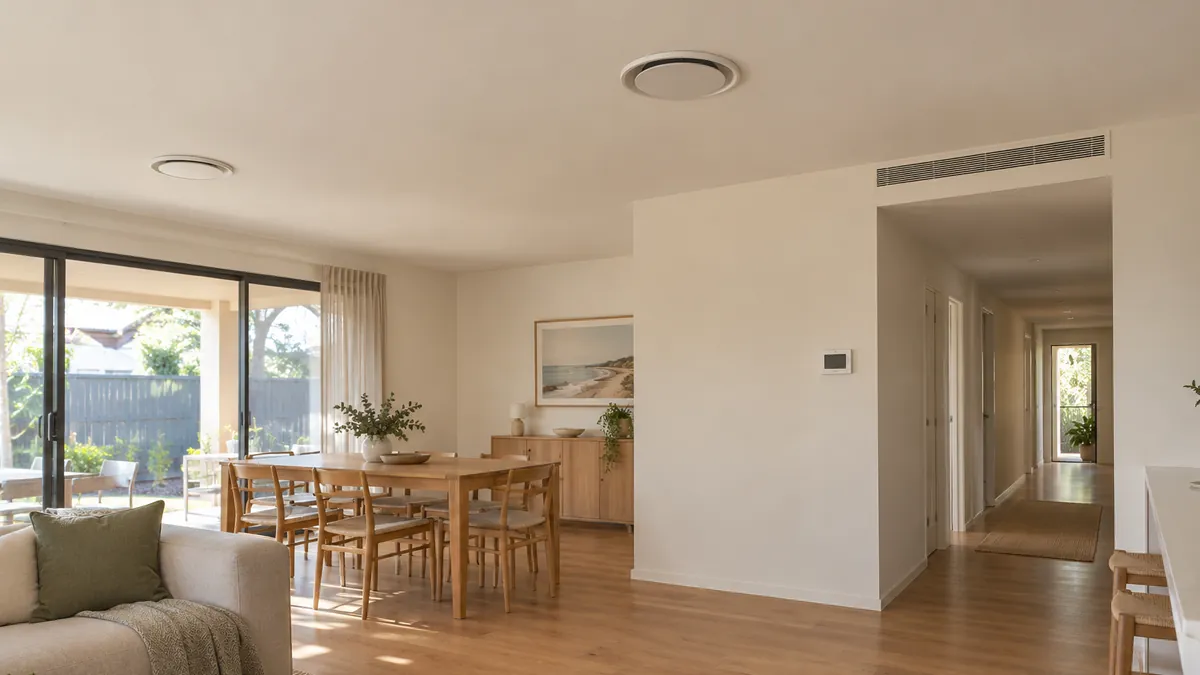
Round ducted air conditioning outlets in the ceiling of an open-plan living area

Ducted Air Conditioning Prices by Home Size

Prices below include GST and come from real installer pricing across Australia (September 2026):

Home size Storeys Typical installed cost
Small (2–3 bedrooms) Single-storey $9,000–$11,500
Medium (3–5 bedrooms) Single-storey $12,000–$14,500
Large (4–6 bedrooms) Double-storey $15,000–$20,000+

These bands come from Global Cool Air, a Perth installer, and installers in other cities land in the same range. Brisbane installers quote $9,000–$10,000 for a small ~170 m² home, $10,000–$14,000 for an average ~235 m² home and $14,000 or more above ~250 m². Ford & Doonan’s Perth price calculator starts from $9,950 for a small home and $11,800 for a large single-storey one. If your home falls between these bands, go through the price drivers below — they explain why two homes of a similar size can end up with quite different quotes.

The installed price for a similar-sized home lands in a similar range in Perth, Brisbane and Melbourne, even though their climates are very different. Climate changes your running costs and which system suits you (our evaporative cooling cost guide covers where each system works); for the installed price, home size, zones and roof access matter far more than your city.

Chart: ducted air conditioning cost by home size in Australia, small $9,000–$11,500, medium $12,000–$14,500, large double-storey $15,000–$20,000+, with a median real price of $16,950

What a 3 or 4-bedroom house costs

These are the two sizes most people ask about. A 3-bedroom single-storey home usually falls between $9,000 and $14,500, depending on whether the installer sizes it as a small or a medium job. A 4-bedroom home typically lands at $12,000–$14,500 on one level and $15,000–$20,000 or more over two storeys.

Expect real quotes to sit toward the upper end of what installers advertise. Seventeen Perth homeowners who shared what they actually paid report a median of $16,950 (sparky.fyi, 2023–2026) — well above the “from $8,500” and “from $9,950” starting prices installers publish. When you see a “from” price, ask exactly what it includes: the number of zones, the controller and removal of your old system are where quotes grow.

What Changes the Price

Diagram of a ducted air conditioning system: outdoor unit, indoor unit in the roof space, supply ducts, zone dampers, return air grille and zone controller

Number of zones

Each zone you add needs its own motor, damper and sensor, plus extra ducting and labour. Budget roughly $700–$1,000 per additional zone: one homeowner with industry experience puts the zone motor itself at $300–$500, and the rest is installation work. The effect shows up clearly when you compare quotes. A homeowner shopping around for a 3-bedroom, single-storey brick home was quoted $11,000 for 2 zones and $13,000 for 4 — a $2,000 difference for two extra zones.

The controller that runs those zones is a separate cost. A Perth installer prices smart controllers and zoning systems at $1,200–$2,500+, and one homeowner reported paying $2,500–$3,000 for an AirTouch controller on its own. Ask for the controller as its own line item so you can compare quotes like-for-like.

A basic setup splits the home into two zones (bedrooms and living areas). One zone per bedroom, plus separate living and dining zones, costs more but lets you cool only the rooms you’re using — which also brings running costs down (see below).

Single-storey vs double-storey

A second storey is the biggest single jump in price. On one Perth installer’s price calculator, a 16 kW system for a large single-storey home comes in at $13,500–$16,000, while an 18 kW system for a double-storey home runs $17,000–$29,000. More ducting, tighter roof access and working around an upper floor all add labour time.

Removing an old system can add to that. One homeowner described taking an old evaporative unit off a second-storey roof as “a huge job”. If your home is double-storey, ask each installer to explain how they’ll run ducting to the upper floor — that’s where quotes for the same house diverge most.

System capacity (kW)

A bigger home, or one with more rooms to cool at once, needs a higher-capacity system, and capacity is one of the biggest cost drivers. Across real homeowner quotes, pricing works out to roughly $700–$1,100 per kW — a guide drawn from real-world pricing, not a fixed installer rate, and it moves with brand, zoning and how easy the installation is.

The range holds up across different system sizes. A 4-zone system in a single-storey Wollongong home was quoted at $8,500; a 12.5 kW system with 6 zones and a touchscreen controller came in at $12,900; and a 14 kW system with 6 zones and smart zoning landed at $19,000, including removal of four old split systems. That last job had more inclusions, which is part of why it sits above the simple per-kW range — bigger, more heavily zoned systems tend to cost more per kW as well as in total.

Ask installers to size the system on-site, from your floor area, ceiling height and insulation, rather than quoting a kW figure over the phone.

New installation vs replacing an existing system

Tell every installer if your home already has ductwork. Reusing ducts from an old ducted reverse cycle system is generally cheaper than routing new ducting through the roof or under the floor, but how much cheaper depends on the ducts’ condition and whether they suit the new system — so ask each installer to inspect them and quote both options.

One exception catches people out: ducting from an evaporative system can’t be reused for refrigerated air conditioning. Switching from evaporative means new insulated ductwork, removal of the old unit and patching the roof, so budget for it as a new installation.

Brand

Premium brands — Daikin, Mitsubishi Electric, Fujitsu, Panasonic — generally cost more than mainstream options like Samsung, LG, Midea or Haier for the same capacity. The gap varies too much by model and retailer to give a single figure. To see it for your own home, ask one installer to quote the same capacity in two brands.

Running Costs

Ducted reverse cycle systems cost more to run than a single split system, because they’re heating or cooling more of the home at once. In the climates where it works, evaporative cooling is cheaper to run again, though the “10x cheaper” claim you’ve probably seen is more nuanced than it looks, as our evaporative cooling cost guide explains.

What you pay per kWh depends on where you live. These are the regulated reference tariffs for 2026–27:

State Electricity price Daily supply charge Source
Queensland (South East) 28c/kWh 176c/day AER Default Market Offer (Energex area)
Victoria 21–48c/kWh, depending on time of day and distribution zone 119–138c/day Victorian Default Offer (ESC)
Western Australia 33.26c/kWh (flat rate) 119c/day Synergy A1 tariff (WA Government)

In Queensland and Victoria these are the caps for standard “standing offer” plans — if you’re on a market plan, you’re probably paying less. In WA, most households pay the single regulated rate.

Zoning is the main lever you control day to day. Cooling only the rooms in use, rather than the whole home, makes a real difference over a summer — so ask your installer about zoning even if you don’t need every zone from day one.

Ducted Air Conditioning Costs by City

Climate and local tariffs change which system makes sense and what it costs to run:

Ducted vs Split System — Which Costs Less?

A split system is cheaper to buy and install than ducted, but it only covers the room it’s installed in. For a single room, or a small home where one or two split units can cover everything you need, a split system is the more cost-effective choice. Our split system installation cost guide covers split prices by room size and kW.

Ducted starts to make more financial and practical sense once you’re trying to cover most of a home. Multiple split units add up fast: three or four indoor units, each with its own installation cost, quickly approach what a single ducted system with the same number of zones would cost. A home full of wall units also looks and sounds busier than one system with vents in the ceiling, and ducted gives you one controller for the whole home instead of several remotes.

The trade-off works the other way for smaller jobs. If you only need to cool one or two rooms, ducted’s upfront cost for ductwork, a central unit and zoning controls buys you nothing a split system can’t do for a fraction of the price. As a rule of thumb, if you’re cooling more than two or three separate areas, get quotes for both ducted and multiple split systems and compare the totals.

The Bottom Line

Most Australian homes pay between $9,000 and $20,000 for ducted air conditioning, and your home’s size, number of storeys and zones decide where you land. Get at least three itemised quotes — zones, controller and removal of the old system listed separately — and check them against the ranges above. If you live somewhere dry and only need cooling, price ducted evaporative before you commit. For local prices, see our guides for Perth and Brisbane.

Frequently asked questions

How much does ducted air conditioning cost in Australia?

Most Australian homes pay between $9,000 and $20,000 installed, depending on home size, the number of zones, and whether it’s a new installation or a replacement. Small single-storey homes sit at the lower end; large double-storey homes with more zones sit at the top.

How much does a ducted aircon cost for a 4 bedroom house?

Typically $12,000–$14,500 for a single-storey 4-bedroom home, and $15,000–$20,000 or more if it’s double-storey. The number of zones and the controller you choose move the final price within those ranges, and real quotes tend to land toward the upper end of what installers advertise.

What size ducted air conditioner for a 4 bedroom house?

A single-storey home with three to five bedrooms usually needs around 12.5–14 kW, and a larger or double-storey home 16–20 kW, based on one Perth installer’s sizing. Ceiling height, insulation and which way the house faces all change the answer, so have the system sized on-site rather than over the phone.

What is cheaper, a ducted or split system?

A split system is cheaper for one or two rooms. Once you need to cover three or more separate areas, three or four split units, each with its own installation cost, quickly approach the price of one ducted system, so get quotes for both and compare the totals.

Which is cheaper to run, a ducted or split system?

A single split system is cheaper to run, because it only cools the room it’s in. A ducted system conditions more of the home at once, but zoning closes much of that gap by letting you cool only the rooms you’re using.

What are the disadvantages of ducted air conditioning?

The upfront cost is the main one: $9,000–$20,000 against $1,500–$5,000 for a single split system. It also costs more to run if you cool the whole home at once, needs roof or underfloor space for the ducting, and is a bigger job to retrofit in a double-storey home.