It seems we can’t find what you’re looking for. Perhaps searching can help.

Replacing a hot water system with the same type typically costs $1,000–$3,000 installed for electric or gas (AUD, prices include GST). Heat pump systems cost $3,000–$6,000 before rebates, and solar $3,500–$8,000. Switching from one type to another adds $400–$2,500 for new electrical circuits, gas lines or relocation.
Here’s what each type costs to buy and install, what a plumber charges for the installation alone, what to do if your system has just failed, and how the running costs change the picture over ten years.
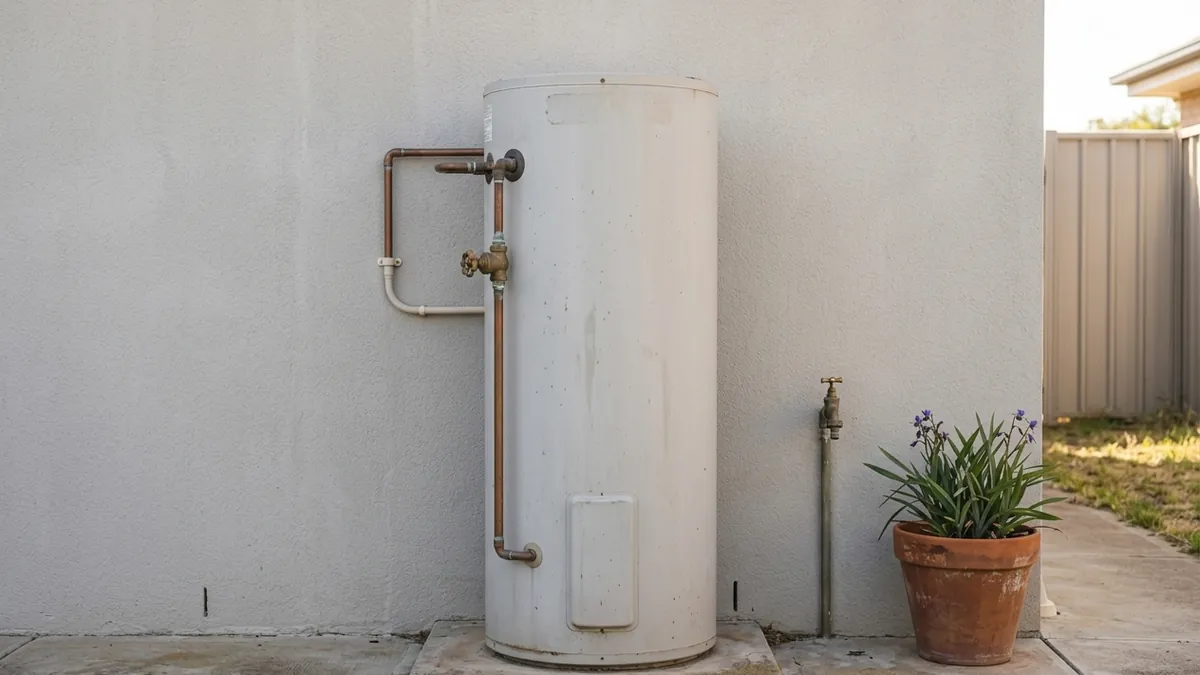
These are supplied-and-installed prices for a standard household system:
| System type | Typical installed cost | Notes |
|---|---|---|
| Electric storage | $1,000–$2,800 | 125 L at the low end; 250–315 L family sizes at the top |
| Gas storage | $1,200–$2,800 | |
| Gas continuous flow | $1,500–$3,000 | Also called instantaneous |
| Heat pump | $3,000–$6,000 | Before rebates |
| Solar (electric or gas boosted) | $3,500–$8,000 | Before rebates |
Prices include GST (September 2026). The ranges combine published pricing from plumbers in NSW, Adelaide and Brisbane with Yellow Pages’ national cost guide.
What homeowners actually pay sits in the middle of that table. Twenty Adelaide homeowners who shared their hot water replacement costs report a median of $2,100, with most paying between $1,600 and $3,050 (sparky.fyi, 2023–2026). If your quote for a like-for-like electric or gas replacement lands well above $3,000, ask the plumber what’s driving it.

The single biggest difference between two hot water quotes is usually whether you’re replacing the same type of system or changing to a different one. The unit is only part of the price; the rest is installation, and that’s where switching costs build up:
| Job | Installation cost (labour and fittings, excluding the unit) |
|---|---|
| Electric to electric (like-for-like) | $400–$800 |
| Gas to gas (like-for-like) | $300–$1,000 |
| Electric to gas | $1,000–$2,000 |
| Any change of technology (new circuit, gas line or relocation) | $400–$2,500 |
| Removal and disposal of the old unit | $150–$400 |
Figures from South Adelaide Plumbing & Gas, Yellow Pages and The Quote Yard (2026).
A like-for-like swap is cheaper because the connections already exist: the plumber disconnects the old unit, stands the new one in the same spot and reconnects it. Moving from electric to gas means running a gas line; moving from gas to a heat pump usually means a new electrical circuit and sometimes a switchboard check. Relocating the unit adds pipework either way.
Ask for a quote that lists the unit, the installation and the removal of the old system separately. It’s the only way to compare two plumbers fairly, and it shows you straight away whether a higher quote comes from a pricier unit or from more work.
New installations must include a tempering valve, which limits the temperature of water reaching bathrooms. Brisbane plumber Fallon Solutions lists it as a requirement. There’s no published price for it on its own, so check that your quote includes it rather than adding it later.
Replace it with the same type. A like-for-like replacement is the fastest and cheapest option, and many plumbers do it the same day. Bunnings, for example, offers same-day and weekend like-for-like replacements at selected stores if you book before 11am.
Switching to a heat pump or solar system while you’re without hot water is rarely quick. It can involve an electrician, rebate paperwork and a unit your plumber doesn’t carry on the van, so it may leave you waiting days.
Before you accept an urgent visit, ask what the plumber charges for after-hours or emergency call-outs. There’s no standard published rate, and it’s the easiest part of an emergency quote to clarify on the phone.
A bigger household needs more stored hot water, and a bigger tank costs more. Rinnai’s rule of thumb is about 50 litres per person plus an extra 50 litres for peak times: roughly 125 litres for one or two people, 250 litres for three or four, and 315 litres or more for five or more. Continuous flow systems are sized differently, by how many showers and taps you run at once, so ask the installer to size one from your household’s habits.
An outdoor unit on the ground is the simplest job. Indoor units need a safety tray and a drain to carry away any leak, and units in a roof space or a tight cupboard take longer to swap. If your old system is somewhere awkward, mention it when you ask for a quote so the price reflects the real job.
Rheem, Rinnai, Dux, Thermann, Stiebel Eltron and Bosch all sell into the Australian market at different price points. Within the same type and size, the brand usually moves the price less than switching technology does. If you’re comparing brands, compare the warranty on the tank or heating element as well as the price.
See the table above: a change of system type can add up to $2,500 in installation work on top of the unit.
The cheapest system to buy is often the most expensive to run. RACV compared yearly running costs for a three-person household:
| System | Off-peak tariff | Peak tariff |
|---|---|---|
| Heat pump | $170 | $230 |
| Heat pump with rooftop solar | — | $105–$120 |
| Electric storage | $650 | $840 |
| Gas storage | — | $645 |
On those figures, a heat pump costs around $480 a year less to run than an electric storage system on off-peak power. Over ten years that’s roughly $4,800, enough to cover most or all of the gap in upfront price between the two. Your own numbers will depend on your tariff and household size, but the direction holds: if your system has a long life ahead of it, the running cost matters more than the purchase price.
Plumbers put typical lifespans at:
Storage tanks wear out faster because the tank itself eventually corrodes. Regular servicing, including checking the anode and the temperature and pressure relief (TPR) valve, is what gets a system to the upper end of its range. If your storage system is past ten years and starting to leak or run out of hot water early, start pricing a replacement before it fails completely: you’ll have time to compare quotes and consider switching type.
Heat pump and solar systems qualify for federal Small-scale Technology Certificates (STCs), which your installer usually applies as a discount on the quote. Their value isn’t fixed: it depends on your climate zone, the system’s size and the market price of certificates. Recent quotes put the discount anywhere from about $300 to $1,200.
Several states add their own programs on top, including Victoria’s Solar Homes and Victorian Energy Upgrades programs and the NSW Energy Savings Scheme. Amounts and eligibility change often, so check the current figure with your state’s energy agency before you rely on it, and ask the installer to show every rebate as its own line on the quote. Be wary of sellers advertising a single fixed rebate figure: the federal certificate value varies by system and location.
For more help comparing heating, cooling and hot water options, see our heating and cooling guides.
A like-for-like electric or gas replacement costs $1,000–$3,000, and it’s the right call when your system has just failed. If you have time to plan, price a heat pump as well: it costs more upfront but can save hundreds of dollars a year to run. Get two or three quotes that list the unit, the installation and the removal of the old system separately, and check they include a tempering valve.
A new electric or gas storage system costs $1,000–$2,800 installed, gas continuous flow $1,500–$3,000, a heat pump $3,000–$6,000 before rebates and solar $3,500–$8,000. Switching from one type to another adds $400–$2,500 for new gas lines, electrical circuits or relocation.
A like-for-like replacement of an electric or gas system usually costs $1,000–$3,000 including the new unit. Twenty Adelaide homeowners who shared their costs report a median of $2,100.
For a like-for-like swap, the installation alone typically costs $400–$800 for electric and $300–$1,000 for gas, on top of the unit. Removing and disposing of the old unit adds $150–$400 if it isn’t already included.
Bunnings doesn’t publish a fixed installation price online; it quotes through its stores. Its service covers Dux gas and electric units installed by a licensed plumber, including disconnecting the old system, and is limited to ground-level residential installations, excluding solar, internal gas and in-ceiling units. Extra charges can apply on the day, so compare the total against a local plumber’s quote for the same unit.
A licensed plumber installs the system, and gas units need a licensed gasfitter. If the job needs a new electrical circuit, which is common when switching to a heat pump or from gas to electric, a licensed electrician does that part.
Electric and gas storage systems typically last around 8–15 years, heat pumps 10–15 years, and continuous flow and solar systems up to 20 years or more. Regular servicing helps a system reach the upper end of its range.
It seems we can’t find what you’re looking for. Perhaps searching can help.