
Home Heating & Cooling Guides for Australian Homes

Choosing heating, cooling or hot water for an Australian home comes down to three questions: what suits your climate, how much of the house you need to cover, and what the system will cost to run over the years you own it. As a starting point, a split system costs around $1,500–$5,000 installed, ducted evaporative cooling $3,000–$7,500, and ducted reverse cycle air conditioning $9,000–$20,000 or more (AUD, prices include GST, September 2026).

The guides in this section help you work through those questions before you ask for quotes. This page gives you the short version of each decision, with the numbers behind it.

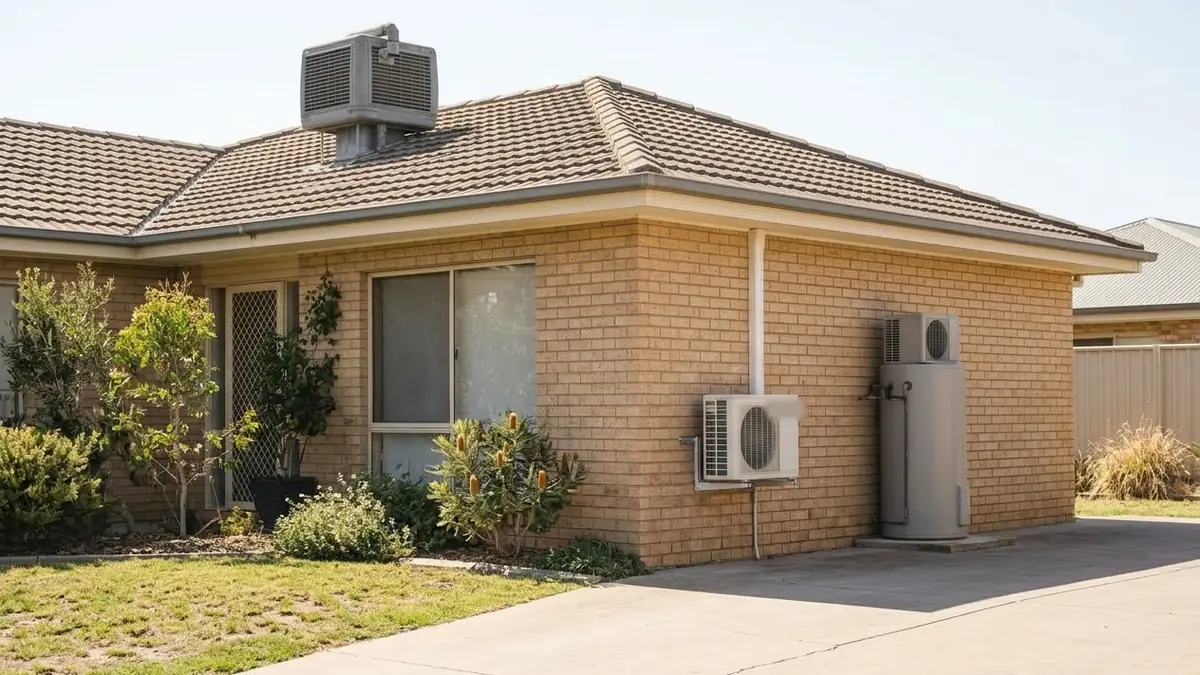
Brick house with an evaporative cooler on the roof, a split system outdoor unit and a heat pump hot water tank

Start With Your Climate

Your climate decides which systems are even on the table, so settle it before you compare prices. Australia’s building code (the National Construction Code) splits the country into climate zones, and the major cities fall into three quite different groups:

City NCC climate zone What it means for your system
Brisbane Zone 2 (warm, humid summer) Humidity rules out evaporative cooling; reverse cycle is the realistic option
Sydney Zone 5 (warm temperate) Coastal humidity makes reverse cycle the usual choice
Perth Zone 5 (warm temperate, dry) Dry summers make evaporative cooling a genuine, cheaper option
Adelaide Zone 5 (warm temperate, dry) Evaporative cooling is widely used and works well
Melbourne Zone 6 (mild temperate) Heating matters as much as cooling; many homes still run gas ducted heating

Two things follow from that table. First, evaporative cooling only makes sense where the air is dry: it cools by evaporating water, and in humid air it runs out of room to do that. Our evaporative cooling cost guide puts numbers on it. Second, if you need heating as well as cooling, reverse cycle does both from one system, while an evaporative cooler only cools.

Perth, Sydney and Adelaide share the same climate zone, yet Sydney is noticeably more humid. When you read a cost guide for your city, local humidity and your electricity tariff tell you more than the zone number alone.

What Each Cooling System Costs to Install

Once you know which systems suit your climate, the next question is how much of the house you need to cover. That decides the price far more than the brand does.

System What it covers Typical installed cost
Split system (single room) One room $1,500–$5,000, depending on size (kW)
Multi-split (one outdoor unit, several indoor heads) Two or more rooms From about $4,200–$4,500 for a premium two-head system, plus $1,000–$1,500 per extra head
Ducted reverse cycle Whole home, heating and cooling $9,000–$20,000+
Ducted evaporative (new) Whole home, cooling only $3,000–$7,500
Ducted evaporative (replacement on existing ducts) Whole home, cooling only $2,800–$5,500, depending on brand
Portable evaporative cooler One room $50–$800

Prices include GST (September 2026). Each range is drawn from installer and retailer pricing, triangulated across at least three independent sources where they exist.

Chart: installed cost of each cooling system in Australia, from a portable evaporative cooler at $50–$800 to ducted reverse cycle at $9,000–$20,000+

A few patterns hold across all of them:

  • One or two rooms: a split system is almost always the cheaper route. Ducting, a central unit and zoning controls buy you nothing a split can’t do for a fraction of the price. Our split system installation cost guide covers prices by room size and kW.
  • Three or more separate areas: get quotes for both ducted and multiple splits. Three or four indoor units, each with its own installation cost, quickly approach the price of one ducted system. Our ducted air conditioning cost guide covers ducted prices by home size.
  • Replacing an old system: tell every installer what you have now. Existing reverse cycle ducts can sometimes be reused, which lowers the price. Evaporative ducting can’t be reused for refrigerated air conditioning, so switching from evaporative costs about the same as a new installation.

What It Costs to Run

The purchase price is a one-off. The running cost comes back every summer and winter, and it can reverse which system looks cheaper over ten years.

Your electricity price

What you pay per kWh depends on your state. These are the regulated reference tariffs for 2026–27, set each year from 1 July:

State Electricity price Daily supply charge Source
Queensland (South East) 28c/kWh 176c/day AER Default Market Offer (Energex area)
Victoria 21–48c/kWh, depending on time of day and distribution zone 119–138c/day Victorian Default Offer (ESC)
Western Australia 33.26c/kWh (flat rate) 119c/day Synergy A1 tariff (WA Government)

In Queensland and Victoria these are the caps for standard “standing offer” plans, so if you’re on a market plan you’re probably paying less. In WA, most households pay the single regulated rate. Check the rate on your latest bill before you use any running-cost figure, including ours.

Cooling: evaporative vs reverse cycle

Sustainability Victoria publishes one of the few neutral comparisons, modelled on a 220 m² home in Melbourne’s climate. Per year, for cooling:

System Annual cooling cost
Ducted evaporative, inverter $25
Ducted evaporative, standard $42
Multi-split reverse cycle, 3.5 stars $124
Ducted reverse cycle, 3 stars, no zoning $172
Multi-split reverse cycle, 2 stars $177
Ducted reverse cycle, 1.5 stars, no zoning $258

You’ll often see evaporative cooling described as “10 times cheaper to run”. That figure compares it with a 1.5-star ducted system with no zoning, the least efficient option in the table. Against a 3-star reverse cycle system, the gap is closer to four times. Evaporative is still cheaper to run where it works; the size of the saving depends on what you compare it with.

These annual figures assume Melbourne’s mild summers and fairly light use. Installers in Perth and Melbourne who model a long, hot summer of daily use put evaporative running costs at $200–$300 a season, or roughly $0.14–$0.35 an hour. Your own cost depends mostly on how many hours you run it.

For a single room, a split system is the cheapest type of air conditioning to run in Australia, at about $0.62 an hour on average nationally (Finder, using energyrating.gov.au data for 4,066 models).

Hot Water Systems at a Glance

Hot water follows the same logic: the cheapest system to buy is often the most expensive to run.

System Typical installed cost Running cost per year (3-person home)
Electric storage $1,000–$2,800 $650 off-peak, $840 peak
Gas storage $1,200–$2,800 $645
Gas continuous flow $1,500–$3,000 —
Heat pump $3,000–$6,000 before rebates $170 off-peak, $230 peak
Solar (electric or gas boosted) $3,500–$8,000 Depends on the booster and your roof

Installed prices include GST (September 2026). Running costs come from RACV’s comparison for a three-person household, which doesn’t cover continuous flow; a heat pump paired with rooftop solar drops to about $105–$120 a year.

If your hot water system has just failed, a like-for-like replacement is usually the fastest option, often done the same day. If you’re planning ahead, compare the running cost column before the price column: over ten years, a heat pump’s lower running cost can outweigh its higher upfront price. Federal certificates (STCs) and state programs cut the upfront cost of heat pump and solar systems, but their value changes with your location and the system, so ask your installer to show the rebate as its own line on the quote. Our hot water system cost guide covers installation and replacement prices by system type.

How to Get a Fair Quote

The price ranges above only help if the quotes you get can be compared with them. A few habits make that possible:

  • Get at least three quotes. Homeowners who compare report large gaps between installers for essentially the same job.
  • Ask for itemised quotes. The unit, installation, controller, extra zones or pipework, electrical work and removal of the old system should each be listed separately. A single bundled number is hard to check.
  • Read “from” prices carefully. Seventeen Perth homeowners who shared what they paid for ducted air conditioning report a median of $16,950, well above the “from $8,500” and “from $9,950” prices installers advertise. Ask exactly what a “from” price includes.
  • Check licences. Air conditioning installers need an ARCtick licence to handle refrigerant. Hot water work needs a licensed plumber, and gas systems need a licensed gasfitter.
  • Have the system sized on-site. Floor area, ceiling height, insulation and orientation all change the capacity you need. A kW figure quoted over the phone is a guess.